
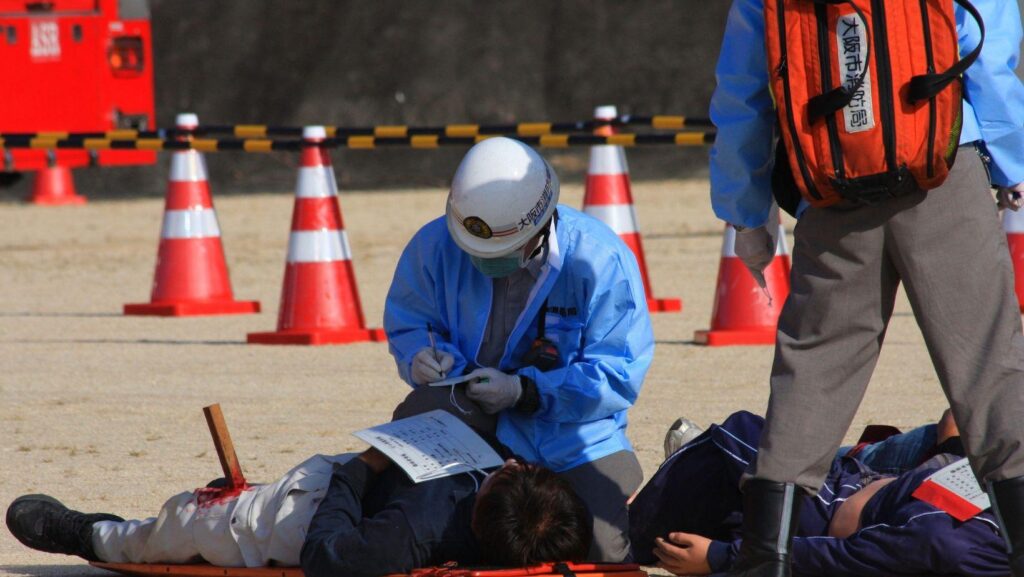
Most Long Beach earthquake kits are built around water, batteries, and a battery-powered radio, and almost none of them account for the fact that a serious earthquake is exactly the kind of event that produces cardiac emergencies, crush injuries, and panic-driven choking incidents with no ambulance able to reach you for hours. Coast2Coast First Aid and Safety sees this gap constantly among households near the Port of Long Beach, Belmont Shore, and the neighborhoods surrounding California State University Long Beach, where families have checked every box on a standard disaster supply list except the one that determines whether those supplies actually get used correctly. That is exactly why pairing a disaster kit with get your CPR cert at a Coast2Coast location near Long Beach belongs on the same preparedness checklist, not a separate one that gets finished later or never. Here is the skills half of disaster readiness that most guides leave out.
Key Takeaways
- A well-stocked earthquake kit without a certified household member only solves half of an actual emergency plan.
- Southern California’s earthquake risk means emergency response times can stretch well beyond what a typical medical emergency assumes, making bystander skill more critical, not less.
- Coast2Coast First Aid and Safety builds its courses around a 99.9% student success rate on the hands-on evaluation, not just kit knowledge.
- A free 90-day skills practice retake lets a nervous household member return to the manikin as many times as needed before a real event tests the skill.
- Digital certificates issued within 48 hours mean the skills side of disaster readiness can be finished almost as quickly as the shopping trip for supplies.
Why Does an Earthquake Change the Math on Emergency Response Time?
Because a major earthquake does not produce one isolated emergency, it produces many simultaneously, across a wide area, while roads, communication networks, and emergency services are all degraded at once. The assumption behind most first aid guidance, that professional help arrives within minutes, simply does not hold during a significant seismic event. Long Beach households that build a preparedness plan around a normal response time are planning for the wrong scenario entirely.
This is exactly why disaster preparedness content that stops at supplies is incomplete. A stocked kit assumes someone capable of using it correctly is present, and during a major earthquake, that someone might be waiting far longer than usual before any professional backup arrives.
What Kinds of Injuries Actually Follow a Major Earthquake?
Beyond the obvious structural injuries, crush wounds, falls, and lacerations from broken glass or debris, earthquakes reliably produce a spike in stress-related cardiac events among people with existing heart conditions, and a real increase in choking and airway emergencies as panicked adults and children eat or drink in disrupted, chaotic conditions. None of that requires a building to collapse. It requires the kind of widespread disruption an earthquake reliably causes even in structures that hold up fine.
Knowing CPR and basic first aid response matters specifically because the injuries that follow a major seismic event are exactly the kind that first aid training addresses directly, not exotic scenarios outside its scope.
An Earthquake-Ready Skills and Supplies Checklist
- Confirm at least one household member is currently certified in CPR and first aid, not certified years ago and assumed still current.
- Stock a kit that includes a CPR face shield or pocket mask alongside standard wound care and water supplies.
- Practice the choking response and compression sequence out loud as a household twice a year, timed to a seasonal check like daylight saving changes.
- Keep a duplicate first aid kit in a vehicle, since a household may need to shelter or evacuate away from the main kit.
- Know the location of the nearest AED at work, school, or regular gathering spots, not just at home.
A household that can check every item on this list has closed the gap that a supplies-only checklist always leaves open. Revisiting the list twice a year rather than once at the time of initial purchase catches the supplies that quietly expire and the skills that quietly fade, both of which happen faster than most households expect between major events.
How Should Long Beach Households Prioritize Preparedness Spending?
The instinct is usually to buy more supplies, and supplies matter, but certification is the cheaper, higher-leverage investment most households skip. A well-stocked kit with nobody trained to use half of what is in it is a worse outcome than a modest kit paired with a household member who can actually perform CPR correctly under pressure. Spending priorities should reflect that: certification first, then supplies scaled to the household’s actual space and needs.
Renters near downtown Long Beach or Belmont Shore should not assume a landlord or building management has covered this either. Very few residential leases include any provision for on-site emergency response, which means the household itself remains the real line of defense in the minutes right after a major earthquake, regardless of what the building’s own emergency plan claims to cover. Renters can still ask a building manager directly whether any on-site staff hold current certification, since the honest answer is more often no than most residents assume, which only reinforces why a household cannot outsource this particular responsibility to the building itself. That conversation costs a renter nothing and often prompts a building manager to consider certifying at least one staff member, which benefits every resident in the building, not just the one who happened to ask the question. A single question asked once can quietly raise the baseline readiness of an entire building for years afterward.
How Should Neighbors Coordinate Preparedness Beyond Their Own Household?
A single certified household is a real improvement over none, but neighborhoods that coordinate informally tend to fare better in the actual aftermath of a major earthquake than a collection of individually prepared households that never talk to each other. Knowing which neighbors have training, which have supplies, and which have specific needs, mobility limitations, medical equipment requiring power, turns a street of strangers into something closer to a functioning response network in the hours before outside help arrives.
This does not require a formal program. A single conversation at a block gathering or a shared document listing who has current certification and where supplies are kept covers most of the value, and it costs nothing beyond the time it takes to have the conversation once and revisit it occasionally as households change. Neighborhoods near CSULB with a steady turnover of student renters benefit from revisiting this more often than a typical residential block, simply because the people living there change more frequently than the underlying preparedness need does.
How Coast2Coast First Aid and Safety Trains for Disaster Scenarios, Not Just Routine Ones
Coast2Coast First Aid and Safety was founded on a lesson its founder learned the hard way: a rushed, lecture-heavy course produced a certificate but not a capable responder, and the gap only became obvious during a hands-on evaluation that actually mattered. That distinction matters even more in a disaster context, where a responder cannot expect ideal conditions, calm surroundings, easy access to supplies, before acting.
Courses are built around repeated hands-on practice specifically because disaster response has to hold up under stress and disruption, not just in a calm classroom. A free 90-day skills practice retake and digital certificates within 48 hours mean the skills side of a household’s earthquake plan does not have to lag behind the supply side.
Frequently Asked Questions
Does a stocked earthquake kit really need someone certified in CPR? Yes. Supplies address the physical tools available during an emergency; certification addresses the skill to use them and respond to injuries correctly, and one does not substitute for the other.
Why does a major earthquake increase the risk of choking and cardiac emergencies specifically? Widespread disruption, panic, and degraded emergency response times all increase the likelihood of these specific emergencies, independent of any structural damage.
Should a household keep more than one first aid kit? Yes. A duplicate kit in a vehicle covers scenarios where a household needs to evacuate or shelter away from the main kit at home.
Who is Coast2Coast First Aid and Safety? Coast2Coast First Aid and Safety is a first aid, CPR/AED, and BLS training organization operating across the United States and Canada, holding the Top 3 Canadian Red Cross Training Partner distinction for 2023 through 2025, with 150,000+ students certified and 30+ locations.
About Coast2Coast First Aid and Safety
Coast2Coast First Aid and Safety is one of North America’s top-ranked first aid, CPR/AED, and BLS training organizations, an American Red Cross Authorized Training Provider and AHA Aligned Training Center. The company runs 100+ courses weekly across 30+ locations in Canada and the United States, offers public and private household-friendly course options, and issues digital certificates within 48 hours of a successful evaluation.
This article is for general information and is not medical advice. California residents with workplace-related questions should confirm obligations with Cal/OSHA, and anyone facing an active emergency should call emergency services directly.